

From Culture Shock · say it like you mean it
No shortcuts II your epic success.
Culture Shock · Purpose of Action Plan
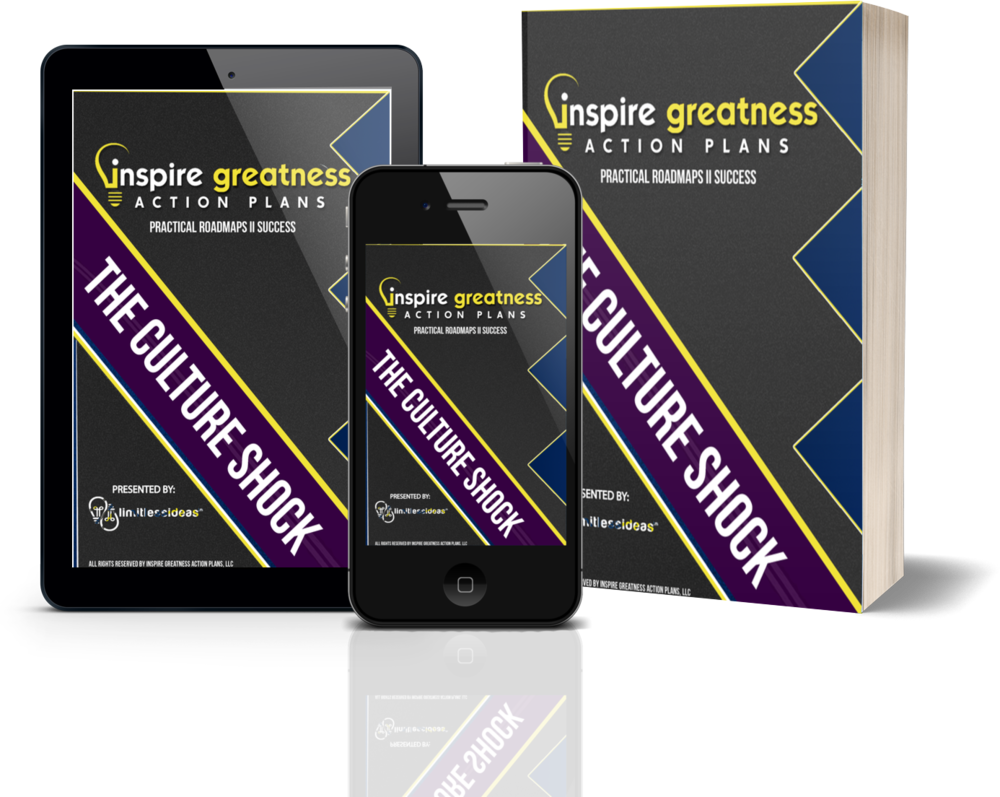
The Culture Shock
Presented by Limitless Ideas
Inspire Greatness Action Plans · Action plan crash course
Core component · What is your “WHY?” ↗
The Inspire Greatness Action Plan “Culture Shock” offers a powerful framework for you to explore your purpose, align your goals with your values, and make strategic decisions. You learn each part, fill it in, rate how much you believe it, and leave with something to do in the next 24 to 48 hours.
Why Culture Shock exists · its core component
What is your “WHY?”
Culture Shock helps you define your purpose in life and business while aligning with your core principles, values and character expectations. Its core principle, “What is your why?”, infuses coping plans and strategies that speed your recovery from setbacks and help you refocus on your objectives. Starting something new can be a culture shock: different values, norms and ways of doing things. Your WHY is what keeps you moving through it.

The reasons it exists
From your page What is your “WHY?” ↗
- Clarity of purposeReflect on what really drives you and define your purpose, so your actions line up with your core beliefs.
- Resilience and recoveryCoping plans and strategies that help you bounce back from setbacks more quickly.
- Refocus on objectivesStay focused on your long-term goals, even when a new venture feels unfamiliar.
- Adaptability and growthA new business can bring a culture shock. Your WHY helps you adapt, learn and thrive in it.
- Alignment with valuesKeep your actions and decisions in line with your deeply held beliefs, with your integrity intact.
- Personal and professional developmentGrow your self-awareness, your cultural competence and the skills to work in diverse environments.
“This action plan empowers individuals to embrace new experiences, learn from different cultures, and achieve long-term success in their chosen endeavors.”
What this covers
What Culture Shock opens with, from the first pages of the plan itself. Then its seven parts, step by step.
Everything at once, with no practical steps: mistakes and wasted time.
How you take it in: by seeing, hearing or doing.
What pressure does to the way you learn, and how you manage it.
What keeps you going when it gets hard.
Who you learn best with, or without.
Same setback. With your WHY and a coping plan, the dip is smaller and the comeback comes sooner.
lost a day
- Reason #1 · the WHYMy children. I want them to grow up watching me build something that is ours.
- Lifetime Goal #1Own a business that runs without me and pays for my family's future.
- Year Goal #1Launch my consulting business and land my first 10 paying clients.
- Month Goal #1Form my LLC, open a business bank account and publish my website.
- Week Goal #1Finish my website's home and services pages and get feedback from 3 people.
- 24–48 Hour Goal #1Do this nextWrite the first draft of my services page tonight.
- Reason #1 · the WHYMy family's security, and work I am proud to put my name on.
- Lifetime Goal #1Lead a team in the field I love.
- Year Goal #1Earn the promotion to team lead at my new company.
- Month Goal #1Master the three systems my role runs on.
- Week Goal #1Ask my manager what success looks like in my first 90 days.
- 24–48 Hour Goal #1Do this nextBook a 20-minute meeting with my manager.
- Reason #1 · the WHYTo be the first in my family to finish a degree.
- Lifetime Goal #1Earn my degree and build a career in healthcare.
- Year Goal #1Finish this school year with a 3.5 GPA.
- Month Goal #1Turn in every assignment on time and go to office hours twice.
- Week Goal #1Finish my biology lab report two days early.
- 24–48 Hour Goal #1Do this nextOutline the lab report and email my study group.
- Reason #1 · the WHYTo be the best version of myself for the people who count on me.
- Lifetime Goal #1Live healthy, debt-free and fully present for my family.
- Year Goal #1Pay off my credit card and run my first 5K.
- Month Goal #1Save $300 and work out three times a week.
- Week Goal #1Cook at home five nights and walk every morning.
- 24–48 Hour Goal #1Do this nextMake tonight's grocery list and set out my walking shoes.
- Reason #1 · the WHYOur community deserves programs that actually change lives.
- Lifetime Goal #1Build an organization that outlives me.
- Year Goal #1Grow our program to serve 200 young people.
- Month Goal #1Recruit five volunteers and launch the mentoring night.
- Week Goal #1Post the volunteer call and meet with two partners.
- 24–48 Hour Goal #1Do this nextDraft the volunteer flyer and send it to the board.
- Reason #1 · the WHYMy comeback is for everyone who counted me out, starting with me.
- Lifetime Goal #1Build a life that no single setback can take away.
- Year Goal #1Get back to steady income and three months of savings.
- Month Goal #1Land part-time work and set a weekly budget.
- Week Goal #1Update my resume and apply to ten jobs.
- 24–48 Hour Goal #1Do this nextRewrite my resume summary tonight and send two applications tomorrow.
Each goal serves the one above it: your lifetime, this year, this month, this week, then the next 24 to 48 hours.
The seven parts, step by step
Open any part to see what you learn, what you fill in, what you try and how it is checked.
1Become your own heroWhat an action plan is, and why it exists.open
You learnA lot of information thrown at you all at once, with no practical steps, leads to mistakes and wasted time. An I.GAP gives you the steps.You fill inNothing yet. This part sets the stage.You trySpot which situation needs a plan, not more information.CheckOne question, with the reason shown either way.2Your learning stylesChoose one or more in each of four groups.open
You learnThe four groups: Core, Stress, ReEnforce and Social, and what each style means. Learning Styles Overview ↗You fill inYour styles, one or more per group. They carry into every plan.You trySort study habits into the style they belong to.CheckMatch a habit to its style.3What is your WHY?The purpose of this plan, and six questions.open
You learnThe plan's four purposes, and why your WHY is the anchor you go back to when things are tough.You fill inThree “Are you ready…” answers, how you'll use your time and opportunities, your reason to keep going, and your anchor or coping tool. Then each one again for your business, and how the two connect (both optional).You tryPick the anchor that fits a tough-day scenario.CheckWhy a WHY matters in a setback.4How much time are you wasting?24 · 168 · 730 · 8,760 hours.open
You learn24 hours in a day, 168 in a week, 730 in a month, 8,760 in a year.You fill inThe hours you lose in a day. The page shows your week, month and year.You tryMove the hours and watch the year change.CheckWhat two lost hours a day add up to in a year.5Motivation and beliefThe 1-to-10 scale and the 8-or-above rule.open
You learnWhy belief comes first, and the rule: if your belief level is less than an 8, build it up or switch. Motivation and Belief ↗You fill inDo you believe you will accomplish your goals? Yes or no, and your belief level.You tryThe belief slider, with the rule on every move.CheckWhat to do with a goal at a 6.6Your WHY and your goalsOne reason, then goals from your lifetime down to the next 48 hours.open
You learnHow a lifetime goal becomes a year, a month, a week and a next step, and why you keep goals in numerical order across plans.You fill inReason #1, then one goal for your lifetime, this year, this month, this week and the next 24 to 48 hours, each with a belief level.You tryTurn a big goal into a next 24 to 48 hour step.CheckWhich goal belongs on which rung.7Finish and actYour plan, your next 24 to 48 hours first.open
You learnCongratulations! You are Finished! Then the next 24 to 48 hours come first.You fill inYour totem, if you want one: something you review daily to stay focused.You leave withYour filled plan, with your 24 to 48 hour goal at the top. Submit it and it is saved with Limitless Ideas, with a copy emailed to you. “Either make excuses or get the job done!”ThenProgress toward your I.GAP certificate. Certificate ↗
Why this is worth knowing
The purpose of this action plan, from its own Purpose of Action Plan.
- Help identify healthy coping tools that can be used in tough times.
- Bring clarity and organization II your ideas, visions and dreams.
- Give motivational steps II realign and remind you of your commitment.
- Inspire the use of effective goal setting that measures your results.
Try one
This is how the course asks. Pick an answer; each one explains itself.
You wrote down a goal for this year and rated your belief at a 6. What does Culture Shock tell you to do?
Sample question. The example inside the answer is new wording for you to review.
What you leave with
- Your learning styles, carried into every plan
- Your WHY: Reason #1 and its belief level
- Goal #1 for your lifetime, this year, this month, this week and the next 24 to 48 hours
- Your answers to the six What is your WHY questions
- Your filled plan, with the 24 to 48 hour goal at the top: submitted to Limitless Ideas, with a copy emailed to you
- Progress toward your I.GAP certificate
What this draws on
- Culture Shock, an Inspire Greatness Action Plan (2025 edition)
- What is your “WHY?” ↗
- Learning Styles Overview ↗
- Motivation and Belief ↗ · Belief Principles ↗
7 parts · 14 answers · 7 belief levels · the next 24 to 48 hours first
Inspire Greatness Action Plans · before you begin
A little about you
Culture Shock
Eleven short answers. Two are required; the rest take a few seconds and shape the examples and the follow-up you get.
Who is filling out this action plan
You are about to start “Culture Shock”. Your plan is kept against the details below.
What this plan is for
How Culture Shock fits your life right now. Pick what is true today; you can change it any time.
You and Inspire Greatness
All optional. Answering changes nothing about your plan; it only tells us how you found it and whether we are already working together.
Why we are asking
An action plan is personal. The same goal reads differently for a founder, a new hire and a student, and Culture Shock is about the moment something new begins. Your name and email keep your plan with you and bring you your copy when you submit it. The rest tells us whose plan this is, so the examples, the follow-up and any support fit your situation and not a textbook one. Everything except your name and email is optional.
Inspire Greatness Action Plans · Action plan crash course
Core component · What is your “WHY?” ↗
The Inspire Greatness Action Plan “Culture Shock” offers a powerful framework for you to explore your purpose, align your goals with your values, and make strategic decisions. You learn each part, fill it in, rate how much you believe it, and leave with something to do in the next 24 to 48 hours.
The action plan itself · fill it in
Your Culture Shock action plan
Part by part, in the plan's own words. Every answer saves on this device as you type. When you finish, your next 24 to 48 hours come first, and Submit action plan saves it with Limitless Ideas.
Part 2 · Learning styles
Learn your way
“Choose one or more learning styles from each category below that you feel you identify with!”
In Culture Shock this page comes right after Become Your Own Hero. Your picks carry into every plan.
Pick at least one in each group.
Part 3 · What is your “WHY?”
Are you ready?
The six questions on the plan's own What is your WHY page. Each one is asked for you, then for your business, then how the two connect. Answer in your own words.
Your own answers are required. The business questions and how they connect are optional: no business yet? Answer for the one you plan to start, or choose No business yet.
1 · Taking the leap
Are you ready to take the leap into your personal greatness?
Example: Yes. I'm done waiting for the perfect time. My kids are watching what I do next.
Definition: Taking the leap means committing to act on your goals now, before everything feels certain. Your personal greatness is the best version of you, the one you are working to become.
Explainer: This is a commitment check. A Yes means you are choosing to act on this plan, not just read it. A No is honest too: it shows you what to work on first.
Are you ready to take your business's next big leap? optional
Business example: Yes. We're ready to open our second location this year.
Business definition: A business's leap is a bold move that changes what the business can do: a new location, a new product, a first hire, or going full time.
Explainer: A business can be ready when you are not, and the other way around. Answer for the business itself: does it have what it needs to make its next move?
How closely is your personal leap tied to your business's leap? optional
Example: Closely connected. Opening our second store is the leap I've been putting off, and my kids will watch me take it.
Definition: The connection is how much your personal answer and your business answer depend on each other, from not at all to the same thing seen two ways.
Explainer: There is no right answer. For some people the business is their personal leap; for others the two run side by side. Knowing which helps you plan your time and money honestly.
2 · Tracking your ideas
Are you ready to track your ideas, visions, and dreams II success?
Example: Yes. I keep a notebook by my bed, and every Sunday night I check what moved.
Definition: Tracking means writing your ideas, visions and dreams down and checking on them regularly, so you can see what is moving and what is stuck.
Explainer: Ideas that live only in your head fade or blur. This asks whether you will keep a record you can look back on and measure.
Are you ready to track your business's ideas, visions and goals II success? optional
Business example: Yes. Every idea goes on the board in our back room, and we review it at our Monday team meeting.
Business definition: In a business, tracking means keeping ideas, plans and results in one shared place, so the team can measure progress and decide what to do next.
Explainer: Businesses lose good ideas when nobody owns the list. Answer Yes if you will set up one place where ideas and results get tracked, and check it on a schedule.
How closely do your personal dreams line up with your business's goals? optional
Example: Somewhat connected. My dream is more evenings with my family. The business goals help with that, but they are not the same thing.
Definition: This asks how much your own ideas and dreams overlap with what your business is trying to achieve.
Explainer: When they line up, every win counts twice. When they don't, you will need to set aside time for each on purpose.
3 · Writing your vision
Are you ready to write your visions and make it plain?
Example: Yes. I wrote my vision on one page and taped it to my bathroom mirror.
Definition: Making your vision plain means writing it simply and clearly enough that you, and anyone you share it with, can understand it at a glance.
Explainer: A vision that isn't written down is easy to change, forget or doubt. Writing it plainly turns it into something you can act on and come back to.
Are you ready to write your business's vision and make it plain for your team and your customers? optional
Business example: Yes. Our vision is painted on the wall behind the counter: fresh bread, fair jobs, a place for the neighborhood.
Business definition: A business vision is a short statement of where the business is going and why. Making it plain means everyone who works with you, or buys from you, can repeat it.
Explainer: Your team can't follow a vision they have never seen. Answer Yes if you will write it down and put it where people will see it.
How closely does your personal vision match your business's vision? optional
Example: Closely connected. I want to give back to the neighborhood that raised me, and so does the bakery.
Definition: This asks whether the future you see for yourself and the future you see for your business point in the same direction.
Explainer: When the two visions match, the business carries you toward your own goals. When they pull apart, it is better to know now than later.
4 · Your time and opportunities
Example: I'll plan every week on Sunday night, guard two evenings for my family, and take every chance to learn from owners who are a step ahead of me.
Definition: Using your time strategically means choosing on purpose where your hours go, so your most important goals get your best time. Opportunities are the openings, people and chances that can move you forward.
Explainer: Everyone gets the same 24 hours. This asks you to name when you will work on your goals and which opportunities you will go after, instead of leaving it to chance.
Business example: We'll take wholesale orders on Mondays, our slowest day, and put every extra dollar toward the second location.
Business definition: For a business, strategy means deciding where its hours, money and people go first, so they serve the goals that matter most.
Explainer: A business has limited hours and dollars too. Name the time, money and opportunities it will put toward its goals first.
How closely does the way you spend your time match the way your business spends its time? optional
Example: One and the same. Right now my hours are the bakery's hours, so guarding my time guards the business.
Definition: This asks how much your own schedule and your business's schedule overlap.
Explainer: If they are one and the same, protecting your time protects the business. If they are separate, plan both, so neither one starves the other.
5 · Your reason to keep growing
Example: I want my kids to see that you can start small and still build something that lasts.
Definition: Your reason to progress is what keeps you improving after the first excitement wears off. It is the personal why behind your growth.
Explainer: Motivation fades; reasons last. Name the reason you will come back to on the days you don't feel like growing.
Business example: Our customers trust us with their birthdays and weddings. Getting better means we never let a celebration down.
Business definition: A business's reason to improve is the purpose that pushes it past good enough: its customers, its team and its mission.
Explainer: Businesses that stop improving fall behind. Name what keeps yours getting better, even when sales are fine.
How closely is your reason to grow tied to your business's reason to grow? optional
Example: Closely connected. Every time the bakery gets better, I become more of the person I want my kids to see.
Definition: This asks whether the reason you grow as a person and the reason your business grows come from the same place.
Explainer: When your reasons are tied together, progress in one fuels the other. When they are separate, keep both in front of you.
6 · Your anchor
Example: A ten-minute walk and rereading my WHY. It brings me back every time.
Definition: An anchor is something steady you go back to when things get hard. A coping mechanism is a healthy habit that helps you handle stress and refocus.
Explainer: Tough days are guaranteed. Choosing your anchor ahead of time means you won't have to figure it out in the middle of the storm.
Business example: Our mission and three months of savings. In a slow month we go back to both before we change anything.
Business definition: A business anchor keeps it steady through hard times: its mission, its loyal customers, a cash reserve, or a plan it follows when things go wrong.
Explainer: Every business hits rough patches. Decide now what it will hold on to, so one bad month doesn't turn into a bad decision.
How closely is your personal anchor tied to your business's anchor? optional
Example: Not connected. My anchor is my faith and my family; the bakery's anchor is its savings and its regulars. Both matter, in different ways.
Definition: This asks whether the same thing keeps you and your business steady, or whether each needs its own anchor.
Explainer: If your only anchor is the business, a bad month can shake you personally too. Many owners find it helps to have one of each.
Part 4 · Your time
How much time are you wasting?
“24 hours in one day. 168 hours in one week. 730 hours in one month. 8,760 hours in one year.” Culture Shock's time page.
Part 5 · Motivation and belief
Do you believe?
“Belief plays a fundamental role in the success of any endeavor.” From the plan's Motivation and Belief page.
Do you believe that you will accomplish your goals/dreams?
Your belief level
“On a scale of 1 to 10 with 10 being the highest, how much do you believe in the stated goal?”
In Culture Shock you rate your belief seven times: once here, once for your reason WHY, and once for each goal from your lifetime down to the next 24 to 48 hours.
Read more: Belief Principles ↗ · Motivation and Belief ↗
Part 6 · Your WHY and your goals
What is your “WHY?”
One reason, then one goal for each step from your lifetime down to the next 24 to 48 hours. Rate how much you believe each one.
Remember: keep goals in numerical order as you use them in different action plans.
Belief level: on a scale of 1 to 10 with 10 being the highest, how much do you believe in the stated goal? If your belief level is less than an 8, you can build it up or switch to a goal that is a level 8 or above.
Example: My children. I want them to grow up watching me build something that is ours.
Definition: Your WHY is the reason behind your goals: the core motivating factor in your life that keeps you going when it gets hard. It is the anchor you come back to when things are tough.
Business example: We opened our bakery so our neighborhood has a place to gather, and so the people who live here have good jobs close to home.
Explainer: Every goal in this plan points back to this reason. When a goal gets hard, your WHY is what you come back to, so choose a reason that truly moves you.
Example: Own a business that runs without me and pays for my family's future.
Definition: A lifetime goal is the one big thing you want to achieve in your life. It sits at the top of your goals: this year, this month, this week and the next 24 to 48 hours are steps toward it.
Business example: Grow our bakery into three neighborhood locations that our family and our team can run for generations.
Explainer: This is the top of your ladder. If you're not sure yet, leave it blank and the other goals still work. If you write one, the rest should lead toward it.
Example: Launch my consulting business and land my first 10 paying clients.
Definition: A year goal is one result you will reach by the end of this year. It is a step toward your lifetime goal, and your month goals build up to it.
Business example: Open our second location and reach $400,000 in sales across both stores.
Explainer: Big goals are reached a year at a time. Pick one result you can measure by the end of the year, so you will know whether you got there.
Example: Form my LLC, open a business bank account and publish my website.
Definition: A month goal is one result you will reach by the end of this month. It moves your year goal forward, and your week goals build up to it.
Business example: Sign the lease for our second location and hire our first shift lead.
Explainer: A year goal is too big to work on all at once. A month goal breaks it into a piece you can finish in about four weeks.
Example: Finish my website's home and services pages and get feedback from 3 people.
Definition: A week goal is one result you will reach by the end of this week. It moves your month goal forward, and your next 24 to 48 hours build up to it.
Business example: Tour three spaces for our second location and post the shift-lead job.
Explainer: This is where plans become action. Pick something you can finish in seven days that moves your month goal forward.
Example: Write the first draft of my services page tonight.
Definition: A 24 to 48 hour goal is the next concrete step you will finish in the next one or two days. It moves your week goal forward, and it is the first thing on your finished plan.
Business example: Call our realtor tomorrow morning and book the three tours for this week.
Explainer: This is the goal you act on first, so it comes first on your finished plan. Make it small, specific and doable in the next day or two.

Part 7 · Finish and act
Your Culture Shock plan
Congratulations! You are Finished!
We are thrilled to celebrate your successful completion of the Limitless Ideas Action Plan. Your commitment, dedication, and hard work have paid off, and we commend you for taking this important step towards personal growth and achievement.
Example: A photo of my kids as my phone's lock screen, so I see my WHY every time I pick up my phone.
Definition: A totem is a personal object or picture you choose to remind you of your goals, kept where you will see it every day. You review it daily so your goals stay in front of you.
Business example: The photo of our opening-day line of neighbors, hung by the register where the whole team sees it every shift.
Explainer: Goals are easy to forget in a busy week. A totem keeps them in sight. Pick something you will see every day, and tie it to your WHY.
Submitting saves your plan with Limitless Ideas, the team behind Inspire Greatness Action Plans, and emails you a copy. Privacy Policy
Inspire Greatness Action Plans · the last page
Culture Shock
What this covered
This one was the WHY. The others are the HOW.
Culture Shock gave you a reason and one goal on every rung. Each plan below picks up one of those rungs and builds it out. Keep your goals in numerical order as you go, and Goal #1 follows you from plan to plan.
Defining Moment turns the next 24 to 48 hours into action steps. Take The Leap puts your core identity on paper, Emergency Snacks is the fail-safe plan for tough times, and Gold Standard for Goals builds a Win-Win. None assumes you have done any other.
Other Inspire Greatness Action Plans
Each one is its own plan. Nothing here assumes you have done any other.
Foundation · who you are and why
Take The Leap
Put your core identity on paper: your top core value, top characteristic, mission statement, vision statement, coping mechanism and motivation factor, each with a belief level.
“Are you willing to risk who you are today to become who you can be tomorrow?”
Open the overview →Culture Shock
Find your WHY, then set one goal for your lifetime, this year, this month, this week and the next 24 to 48 hours, each with a belief level.
Open the overview →The Grind · from the year to the next 48 hours
Yearly Dreams
Name your top outcomes for the year and the habit you will change, then track your most important goal month by month.
Open the overview →Monthly Gems
Celebrate last month's victories, recap what you learned, and check off this month's goal tasks with the hours each one took.
Open the overview →Weekly Trophies
Five yes-or-no questions, then timed steps: affirmations, last week's wins, your weekly impact, and your most important tasks from Monday to the weekend.
Open the overview →Defining Moment
Reflect, Evaluate, Assess, Implement: realistic action steps you commit to for the next 24 and 48 hours.
Open the overview →Defense and Win-Win
Emergency Snacks
A fail-safe plan for tough times: the threats to your goal, three coping tools for each, and a quick action for courage.
Open the overview →Gold Standard for Goals
Create a Win-Win by learning what matters to a customer or business partner, then a S.W.O.T. and three Win-Win actions.
Open the overview →Keep going: the I.GAP library for this plan
The one-page guides this plan draws on. Each opens its PDF until its own crash course is built.